
This Fall Prevention Professional Conference is sponsored by the PTTC NCO
Title: Fall Prevention Professional Conference 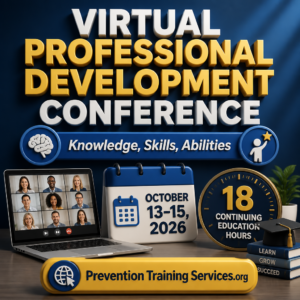
Format: Virtual via Zoom
Date: October 13-15, 2026
Time: 9 am- 4:00 pm CST
Continuing Education Hours: 18 in Multiple IC&RC Domains
Price: $450/ $475
Registration Link: Click here to register Contact us here to register 5 or more and provide one credit card payment.
 This Fall Prevention Professional Conference is sponsored by the PTTC NCO
The PTTC NCO is helping prevention professionals access substantive continuing education, pursue opportunities that support certification and credentialing, and build the knowledge and skills needed to strengthen prevention practice in communities nationwide.
The PTTC NCO is housed at the University of Missouri–Kansas City (UMKC), Kansas City’s only Carnegie R1 research university. As part of UMKC, the NCO contributes to the university’s broader commitment to translating knowledge and expertise into meaningful impact for communities—extending that impact to the substance use prevention workforce nationwide.
Schedule:
October 13th
1) 9:00-10:30-“Fun-Raising”: Mastering the Art of the Ask to Build Community Support and Secure Unrestricted Funds
2) 10:30-12:00- Building Your Professional Prevention Identity
3) 1:00-2:30- Using Design-Thinking for Planning and Action in Substance Misuse Prevention and Response
4) 2:30-4:00- Mapping Your Personal Energy: Real-Time Nervous System Resilience to Restore Energetic Boundaries
October 14th
5) 9:00-10:30- Strengthening Evaluation to Communicate Impact and Support Funding
6) 10:30-12:00- Around the World in 80 Bets: A Journey Through America’s Youth Gambling Epidemic
7) 1:00-2:30- Moving Environmental Scan Results into “little p” Policies
8) 2:30-4:00- Maintaining Audience Engagement
October 15th
9) 9:00-10:30- Cultivating Champions
10) 10:30-12:00- Tokens are for Arcades: Engaging Youth in a Meaningful and Purposeful Way
11) 1:00-2:30- Putting the Engage Back in Engagement
12) 2:30-4:00- From Presenter to Facilitator: Designing Learning, Not Just Delivering Content
Workshops are scheduled in Central Time.
Use the time zone converter and then enter Austin, Texas.
All virtual workshops are subject to change.
Course Descriptions:
1) “Fun-Raising”: Mastering the Art of the Ask to Build Community Support and Secure Unrestricted Funds Grants provide critical support, but unallocated funds give your agency the freedom and flexibility to innovate, grow, and meet real-time community needs. Learn how to put the “fun” in fundraising while mastering the “Art of the Ask.”
Using real-world case studies—including community-wide events like hat shows and music festivals, high-impact donor luncheons, direct mail campaigns, and matching-gift drives—this presentation delivers practical strategies to mobilize local community support. Attendees will discover how to craft compelling, mission-driven asks that turn casual event participants and first-time givers into lifelong financial partners, securing vital, flexible revenue that keeps your agency thriving for years to come.
Skill: Discover how to raise unrestricted program funds.
Objectives: Upon completion of this program, the participant will be able to list proven fundraising approaches to secure flexible revenue and design purposeful community events that build awareness, reach new audiences, and foster long-term donor support.
Presenter: Mitchell Moore
2) Building Your Prevention Identity- Prevention work doesn’t always come with a clear road map and for many professionals just entering the field that can feel both exciting and disorienting. Most people don’t plan their way into prevention; they find it, stumble into it, or discover it wearing a completely different hat. From understanding the various roles of prevention professionals, to finding your niche within a broad and growing field, this session offers a candid and energizing look at the journey ahead. Participants will discover their professional strengths and leave with practical strategies for building the relationships that will sustain and grow their careers. Whether you’re leading curriculum in schools, community-based, or still figuring out where you fit, this session was made for you.
Skill: Networking
Objectives: Describe the scope of prevention as a career field. Develop at least one professional relationship and learn more about opportunities to network with others in the field.
Presenter: Louise Montag
3) Using Design-Thinking for Planning and Action in Substance Misuse Prevention and Response-Prevention professionals are often asked to collect data, conduct needs assessments, and develop plans, yet many organizations struggle to translate that work into strategies that are actionable, collaborative, and grounded in community needs. This session introduces a human-centered design (HCD) approach to strategic planning, providing a practical model for moving from data and assessment to shared understanding, co-created solutions, and effective implementation. Participants will conduct human-centered activities through both breakout rooms and team based discussions. Together we will learn how to adapt a simple HCD model for collaborative planning rooted in HCD theory that can be applied to different public health and community planning domains.
Skill: Conducting Human-Centered Design (HCD) Activities for their organization
Objectives: Translate community data into meaningful insights to engage partners and community members in collaborative planning processes.
Presenter: Avanti Godbole
4) Mapping Your Personal Energy: Real-Time Nervous System Resilience to Restore Energetic Boundaries- Reclaim your energy today! Join us to map personal daily energy to identify, pre-plan energy leaks and build-in opportunities for real-time resilience to reset in the moment, recharge throughout the day and restore appropriately between tasks and clients to meet the demands of each day. This session guides a simple mapping process and the tools for practical nervous system resets and energetic boundary tools to reduce daily stress-load, clear client residue and restore whole self-presence using the ABCs of Presence to micro reset between sessions and return home with more of you intact. As community mental health peers/professionals, we will normalize and address the real human challenges to practicing self-care in the moment, leading with full presence, slowing-down without collapsing and feeling a need to GO-GO-GO! Attendees will learn through humor, shared lived experience, neuro education and everyday skills to harness their personal energy to manage daily stressors for burnout prevention. This energizing and restorative presentation is the foundation of the Self-Care and Resilience, a trauma-informed, nervous system-based resilience program that builds self-awareness, distress tolerance, self-regulation and other tools to live life fully without the exhausting secondary energy leaks.
Skill: Map personal daily energy to identify, pre-plan energy leaks and tool-up with real-time resilience skills to reset in the moment, recharge throughout the day and restore appropriately between tasks and clients to meet the demands of each day.
Objectives: Identify and map their nervous system state at the beginning, throughout and at the completion of each day with the intention to build self-awareness and tools for real-time self-care. Recognize real-time energy, personal needs and mitigate risk for burnout related pattern of go-go-go collapse.
Presenter: Jen Schneeman
5) Strengthening Evaluation to Communicate Impact and Support Funding Prevention- Professionals are routinely asked to collect data, report on outcomes, and demonstrate impact. Yet even with significant effort in these areas, many organizations continue to face a fundamental challenge: clearly articulating what has changed as a result of their work, and communicating that impact in a way that resonates with funders and stakeholders. This session introduces the Clarity, Impact, Funding (CIF) framework as a practical model for addressing this challenge. The session will begin with an overview of the framework and a discussion of where organizations commonly encounter difficulties, particularly in translating data into meaningful insight. The focus will then shift to rethinking the role of evaluation. Rather than approaching evaluation solely as a reporting requirement, participants will explore how it can be used as a tool for communicating value. Cost-effectiveness will be discussed as one approach, alongside other value lenses such as risk reduction, system impact, and improvements in access and community trust. Using examples from prevention practice, the session will walk through a structured approach to connecting program activities to outcomes and translating those outcomes into clear, credible value statements. Emphasis will be placed on practical application, with tools and strategies that can be implemented using existing data and within current organizational capacity. Participants will leave with a clearer understanding of how to position their work, strengthen their evaluation approach, and communicate impact in ways that support strategic decision-making and funding.
Skill: How to use data to communicate the value of prevention work to funders.
Objectives: Use the Clarity- Impact- Funding (CIF) framework to articulate how their organization can effectively use data to drive decisions and secure funding at their prevention organization. Describe five distinct ways to define and communicate program value (for example, cost-effectiveness, risk reduction, or system impact) using a prevention-focused example. Develop one clear value statement that links a program activity to a measurable outcome and articulates its relevance for funders or stakeholders.
Presenter: Drew Reynolds
6) Around the World in 80 Bets: A Journey Through America’s Youth Gambling Epidemic- From fraternity houses in the South to high school assemblies in the Mountain West, gambling prevention speaker Saul Malek has spent years on the front lines of America’s youth gambling epidemic. This session draws directly from hundreds of real engagements across 30+ states to paint an honest picture of how gambling behavior actually looks and spreads among young people today. Not the million-dollar loss stories. The ordinary ones. The college student who started with a five-dollar parlay. The high school sophomore who learned the odds from an online ad. The fraternity member who thought he had an edge. Participants will leave with a current, ground-level understanding of the gambling landscape young people are actually navigating and a practical framework for evaluating whether their existing wellness programming is equipped to address it.
Skill: The participant will learn how to strengthen their existing gambling prevention efforts through a practical framework
Objectives: Participants will be apply a practical framework for identifying at-risk youth early, initiating supportive conversations, and connecting families to appropriate resources before harm escalates. Evaluate and strengthen their existing prevention efforts to address gambling disorder as a distinct and growing behavioral health concern
Presenter: Saul Malek
7) Moving Environmental Scan Results into “little p” Policies- You’ve done the environmental scan, you have the results, now what? This pivotal point in local policy work often leaves prevention providers unsure of what to do with the data and how to make the next step. The approach taught in this session has worked in rural and frontier counties, and will give learners the skills to confidently work towards alcohol policy change at local events using the support of their coalition.
Skill: Conduct an environmental scan at community events.
Objectives: Utilize environmental scan results to identify potential local policy recommendations and environmental changes.
Presenter: Nicole Hackley
8) Maintaining Audience Engagement- Whether we are presenting information, providing education sessions, facilitating task meetings or facilitating other discussions, Prevention Specialists need to know how to keep their audience and/or participants engaged. Join us as we explore 6 ways to re-engage any audience, practice 7 skills necessary to facilitate meaningful discussions, and identify 8 common “non-productive” behaviors from audience/participants and how to handle them.
Skill: Key skills in re-engaging audiences, facilitating meaningful discussions and responding problematic participants. Special attention will be paid to surfacing feelings & opinions, paraphrasing, summarizing, asking for clarification or examples.
Objectives: Participants will diversify their facilitation toolbox by identifying 2 of the 7 facilitation skills they currently do not use that they will commit to work on and identify ways to prepare themselves to practice those skills more often.
Presenter: Allison Sharer
9) Cultivating Champions- We all love when people will come to our aid and defense. We feel a sense of pride and security when we know that people are for us. Fostering the relationships that build champions is important for all coalitions and prevention programs. Let’s learn together how to create champions that will push prevention forward and be there right with you along the way!
Skill: Relationship building and good communication
Objectives: Participants will create sustainable avenues of communication to smoothly move members to higher levels of involvement.
Presenter: Trevon Norman
10) Tokens are for Arcades: Engaging Youth in a Meaningful and Purposeful Way- The role of youth in primary prevention cannot be understated – they should be included in the assessment, capacity, planning, implementation, and evaluation of prevention efforts. All too often, substance use prevention coalitions find a youth representative but unconsciously treat them as a token member or recipient of services, rarely engaging with them and the vast potential they possess. This unintentional tokenism is a barrier to youth reaching their full potential with prevention work; instead, youth can and should be engaged in leadership opportunities, strategic discussions, and solutions to the identified problems. What if we engaged youth in a way that was meaningful and purposeful to them AND to the adults working on the coalition? This session will help you understand the essential nature of youth involvement in prevention coalitions, how to make prevention work attractive to youth, how to handle challenges with youth engagement, and how to sustain involvement for the long-term. Let’s explore ways to shift mindsets and amplify prevention work through youth engagement.
Skill: Youth engagement
Objectives: Describe why youth involvement is essential for substance misuse prevention work and identify at least 3 ways that youth engagement could happen in your community and Build skills around recruiting, retaining, and engaging youth in prevention work.
Presenter: Rikki Barton
11) Putting the Engage Back in Engagement- Feeling stuck, short on time, or struggling to engage volunteers and partners? You’re not alone. Many organizations are being asked to do more with less making it harder to build relationships, keep people involved, and maintain community support. This session focuses on practical ways to re-energize your efforts by strengthening relationships, making the most of your time, and working better together. Learn how to meet people where they are, create welcoming and inclusive spaces, and build trust across your community. You’ll walk away with real-world strategies, tools, and ready-to-use ideas to boost engagement, grow support, and keep your work moving forward.
Skill: How to effectively engage the community to create sustainable change.
Objectives: Identify effective strategies to engage volunteers, partners, and community members. Understand how creating welcoming, respectful environments helps involve people from all backgrounds.
Presenter: Melissa Moore
12) From Presenter to Facilitator: Designing Learning, Not Just Delivering Content
The prevention field has invested heavily in developing evidence-based curricula and preparing professionals to deliver prevention content. Yet few prevention practitioners receive formal instruction on how adults learn or how to facilitate meaningful learning experiences. As a result, many trainings remain instructor-centered, emphasizing information delivery over participant engagement and application.
This interactive workshop introduces participants to the concept of Instructor-Led, Learner-Centered (ILLC) training—a practical approach that shifts the trainer’s role from content expert to learning facilitator. Rather than focusing on covering every slide, participants will discover how to design learning experiences that promote discussion, critical thinking, collaboration, and workplace application.
Through demonstrations, small-group activities, and guided reflection, attendees will experience learner-centered instruction firsthand while exploring practical techniques they can immediately incorporate into their own trainings. Participants will leave with a simple framework for transforming existing presentations into engaging learning experiences that improve retention, increase participation, and strengthen the transfer of learning beyond the classroom.
Skill: Participants will develop practical skills to transform traditional presentations into interactive learning experiences.
Objectives: Compare instructor-centered and learner-centered training approaches and identify strategies that promote active engagement, collaboration, and adult learning. Apply at least three learner-centered facilitation techniques to redesign an existing prevention presentation into a more interactive, culturally responsive learning experience.
Presenter: Steve Miller
Presenters:
1) Mitchell Moore, BAT, LCDC, ICPS, IADC, is a dynamic educator who has a passion for serving those who serve by designing and delivering professional training across America.
He is an internationally certified prevention specialist and licensed chemical dependency counselor who has extensive experience working with youth and families in both prevention and recovery settings. He has served as a counselor, prevention specialist, grant writer, program director and executive director of a charitable organization.
He is currently the Director of Prevention Training Services, a member of the IC&RC Prevention Group, the vice-chair of the Texas Certification Board, parliamentarian of the Texas Association of Addiction Professionals, a member of the Prevention Innovators Think Tank and a beekeeper.
2) Louise Montag, BS, CPC, is a public health professional with a decade of experience, specializing in substance misuse prevention. As the Owner and CEO of Montag Forward Solutions LLC, she provides strategic guidance and training to prevention professionals nationwide. Formerly the Executive Director at Prevention Network, she has led community-based prevention initiatives and developed numerous resources for the field. Recognized with awards such as the Certified Prevention Consultant of the year, Prevention Specialist of the Year, Top 10 in 10 Years, and the Arthur Ashe ESPY, Louise is committed to fostering effective leaders and sustainable organizations dedicated to social good. In her free time, she enjoys traveling with her husband, staying active, and spending time with her dogs.
3) Avanti Godbole, MPH is an Evaluation Associate at Common Good Data. Avanti is a public health professional focused on making research useful and accessible. She has led applied research and evaluation across the federal government, academic research teams, nonprofits, and digital health startups. Avanti completed her Master of Public Health at the University of North Carolina and her Bachelor’s degree at the University of Virginia.
4) Jen Schneeman is a soul-driven scientist with 24 years in health & human performance. She is trauma-informed nervous system resilience specialist, board-certified holistic mental health coach and founder of REAL Human Performance. Early in her career, Jen served as a science + tech advisor at DARPA/Defense Sciences Office and the Air Force Research Lab, Human Performance Wing, studying epigenetics – how trauma, nutrition, and stress uniquely impact human resilience and also inform future determinants of health.
She translated those scientific insights into real-time resilience training and has coached two NFL teams, four military branches, dozens of corporations, hundreds of health-conscious leaders, recovery peers and treatment professionals and thousands of other real humans just like us, looking to optimize their personal energy for more flow and less drag in life.
In 2016, Jen authored and tested Self Care and Resilience (SCAR) – a personalized nervous system-based burnout resilience program that guides people to unlock their stuck stress patterns, expand their energy capacity and become burnout proof. Jen guides real humans to live a life of real-time resilience without the stress of nonstop thoughts and exhausting energy leaks.
Jen doesn’t just coach real-time resilience, she lives it, having navigated burnout in a post-9/11 culture of constant go-go-go-collapse. She uses humor, lived experience and science-backed methods that guide real humans to live with more awareness, self-trust and peace to thrive amidst the everyday stressors.
Jen believes in the power of peer support and is an ally to youth leaders and advocates across prevention, recovery, and treatment spaces, guiding others to hold trauma-informed spaces and carry the grounded presence needed to lead, connect and create meaningful change. In addition to working with high-impact helping peers and professionals, Jen also facilitates therapeutic nervous system resilience programs within survivor groups of sexual assault, addiction, PTSD and TBI. She holds the steady belief that when we manage our personal energy, we increase sustainability for ourselves, for our communities and for our planet. For her own battery recharging, you can find Jen outside in nature: gardening, kayaking, hiking and camping with her husband, daughter and sheepdog, Willow.
5) Drew Reynolds works with behavioral health and prevention organizations to strengthen how they measure and communicate impact. As founder of Common Good Data, he helps teams connect data, strategy, and funding into a clear, usable system. His work focuses on turning everyday program data into credible value stories that support sustainable funding.
6) Saul Malek is a professional speaker specializing in gambling addiction prevention and education. Saul developed a gambling addiction as a college sophomore, losing money, time, relationships, and nearly his life. Since entering recovery in 2019, he has become an in demand speaker, sharing his story with schools (both K-12 and colleges and universities), athlete mental health organizations, suicide prevention groups, parent groups, popular news outlets (including New York Times, National Public Radio, Public Broadcasting Service, and Dallas Morning News). He has keynoted conferences including the Connecticut Council on Problem Gambling annual conference, the Wisconsin Council on Problem Gambling annual conference, and Mental Health America Greater Dallas Adolescent Symposium. He has appeared on Dr Phil Primetime and was a TedX speaker at the University of Alabama at Birmingham. WATCH SAUL’s DEMO REEL
7) Nicole Hackley Since joining the primary prevention field in 2009, Nicole was worked under many federal and state grants, currently serving as the Executive Director of Prevention Support Services, and the President of the Montana Prevention Certification Board. Her work has included direct prevention support to rural and frontier communities, as well as training, technical assistance, and mentoring to prevention providers in Montana and North Dakota. She lives in Western Montana, enjoying hiking, fishing, lake days, and time in the mountains. When not doing those activities you can find her doing typical millennial mom activities like gardening, yelling at her kids’ sporting events, and reading books with questionable main characters.
8) Allison Sharer OCPC, has worked in the Prevention field since 1983. She is an independent trainer and consultant, and the President of Wingspan Training, LLC. Her experience includes work with businesses committed to creating and maintaining Drug-free Workplaces, as well as youth-led prevention, community-based prevention and environmental prevention. She has developed and presented workshops, training and other educational opportunities for a wide variety of audiences.
9) Trevon Norman born in 1982, is an accomplished Advanced Certified Prevention Specialist who has been implementing substance abuse programs and environmental change in his community for 10 years. He started out as a Prevention Specialist and recently became Coalition Coordinator for the Prevention Alliance for Wichita. His passion for his community shows in the partnerships and leadership skills which drive him and the coalition to build a healthier community. His passion is boosted by his love for his family (wife and two children), his church (Life Church Burkburnett), and his many friends and co-workers in Prevention. He is also a Consultant with PTS (Prevention Training Services), certified to train in Prevention Ethics, and a certified SAPST Trainer with C.A.R.E. Consulting Group.
10) Rikki Barton Rikki Barton has a passion for moving individuals and communities onward in their goals. She is the Founder/Lead Consultant of Onward Consulting and is a Certified Prevention Specialist. Rikki has nearly two decades of prevention field experience and currently serves as a consultant to assist organizations, coalitions, and state/federal agencies in the areas of substance use prevention, suicide prevention, and mental health promotion. In her free time, Rikki loves to travel to adventurous places and be active in nature with her rescue dog, Oreo.
11) Melissa Moore has worked in Public Health for over 25 years, leading prevention and coalition efforts in multiple diverse communities. Emphasizing the need to go beyond education to address the factors that contribute to substance abuse, Ms. Moore has helped lead assessment, planning, implementation and grant writing efforts to transform the way communities tackle this daunting burden. An expert in engagement and communication, Ms. Moore is always looking for opportunities to take great ideas and move them into tangible actions answering the age-old question…We recognize this is an issue, now what can we do about it?
12) Steve Miller is a prevention specialist, trainer, and storyteller with more than two decades of experience helping communities address substance misuse, mental health, and related public health challenges. He has designed and delivered trainings for prevention professionals, coalition leaders, educators, healthcare providers, and community stakeholders across the country. Known for his engaging and practical facilitation style, Steve combines evidence-based prevention principles with real-world experience to create learning environments that are interactive, relevant, and immediately applicable. As the founder of Voices and Vision of Prevention, he is passionate about translating complex concepts into accessible conversations that strengthen communities and inspire action.
Julie Stevens MPS, ACPS, ICPS is an Advanced Certified Prevention Specialist and was a Licensed Chemical Dependency Counselor for 20 years. She has served as Director of Prevention for the Texas Commission on Alcohol and Drug Abuse, and Training Specialist for the University of Oklahoma’s Southwest Prevention Center.
Ms. Stevens serves on the Texas Certification Board of Addiction Professionals and is chair of the Prevention Subcommittee. She has served as Member At Large of the Board of the International Certification and Reciprocity Consortium and Advisor to the Prevention Committee. She has a bachelor’s degree in psychology from Baylor University and a Masters of Prevention Science from the University of Oklahoma.
In addition, Ms. Stevens serves on SAMHSA CSAP’s Substance Abuse Prevention Workforce Assessment College/University Stakeholder workgroup and SAMHSA CSAP’’s Certification Stakeholder workgroup. She also serves on the PTTC Network Coordinating Office (NCO) Advisory Board.